
.png)


Marco Antonio Rubio: From U.S. Senator to Champion of UAP Disclosure
- Skywatcher's Hub

- Feb 24, 2025
- 5 min read
Updated: Mar 1, 2025
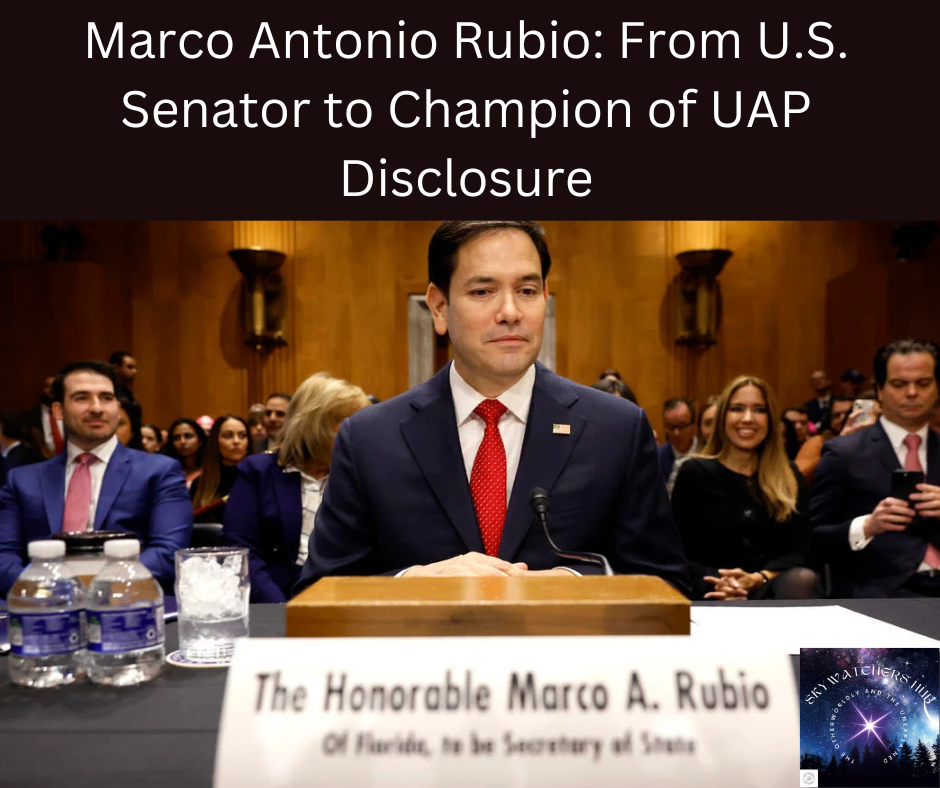
Marco Antonio Rubio, a prominent American politician, has served as the U.S. Senator from Florida since 2011, with a career marked by his commitment to national security, defense, and a forward-thinking approach to emerging threats. Known for his pragmatic political stance and his ability to build bipartisan support, Rubio has long been a figure of interest in Washington, D.C. In recent years, however, his involvement in the Unidentified Aerial Phenomena (UAP) discussion has propelled him into the spotlight for an entirely different reason.
As a U.S. Senator, and more recently in his role as the 72nd Secretary of State, Rubio has taken a particular interest in UAPs—an issue that has captivated the public and defense experts alike. Rubio’s efforts to ensure that the government takes UAPs seriously and is transparent about what it knows have sparked renewed conversations about the need for greater disclosure regarding these mysterious phenomena.
But what has shaped Marco Rubio’s position on UAP disclosure, and why has he become one of the most prominent political figures advocating for transparency in this area?


A Career Rooted in National Security and Defense
Rubio’s political journey began in Florida, where he served as both a member of the Florida House of Representatives and the Speaker of the Florida House before being elected to the U.S. Senate in 2011. His tenure in the Senate has been defined by his focus on foreign policy, national security, and defense issues—areas in which he has gained significant influence. As a member of the Senate Intelligence Committee and the Senate Select Committee on Intelligence, Rubio has been involved in overseeing U.S. intelligence operations, ensuring that national security threats are addressed swiftly and decisively.
During his time in the Senate, Rubio became known for his work on a broad range of national security issues, including cybersecurity, terrorism, and military readiness. His position on the Intelligence Committee gave him insight into the most sensitive matters regarding U.S. defense and security, and it was within this context that Rubio became increasingly interested in the issue of UAPs.


Rubio's Engagement with UAPs: A Catalyst for Change
Rubio’s interest in UAPs began in earnest in the late 2010s when the U.S. government began to take more serious steps toward investigating and disclosing information related to UAPs. Rubio was vocal about his concerns that UAPs could represent a serious national security threat. In 2020, he made headlines when he supported the $2.3 trillion coronavirus relief package, which included a provision that required the U.S. government to release information about UAPs within 180 days.
In his remarks, Rubio emphasized that the U.S. government needed to be more transparent about what it knew regarding UAPs, especially in light of the increasing number of sightings and encounters by military personnel. As a member of the Senate Intelligence Committee, Rubio played an instrumental role in demanding that intelligence agencies, including the Pentagon, disclose what they had learned about UAPs through programs like the Advanced Aerospace Threat Identification Program (AATIP).
Rubio's position was clear: UAPs were not just an obscure or fringe issue; they were a national security concern that needed to be taken seriously. He repeatedly stated that if UAPs were being observed by the U.S. military, it was essential to understand their nature and origin, particularly if they were associated with foreign adversaries possessing advanced technology.
In 2020, Rubio’s push for UAP disclosure culminated in the COVID-19 relief bill, which mandated that the Director of National Intelligence (DNI) and the Secretary of Defense submit an unclassified report to Congress on UAPs. This report, released in June 2021, was a significant milestone in the ongoing UAP disclosure effort, marking a shift toward greater public transparency on the topic. Rubio’s influence as a key figure in this legislative process helped ensure that the government began to take the issue seriously and address it in a more structured manner.


A Political Leader Focused on National Security
Rubio’s interest in UAPs is not only about transparency but also about ensuring the safety and security of the United States. As someone deeply committed to national defense, Rubio understands that UAPs—whether they are classified as foreign technology, advanced military systems, or something else entirely—could have significant implications for U.S. security.
The idea that foreign adversaries might be operating in U.S. airspace with advanced, unexplained technologies raises significant concerns. Rubio’s calls for UAP disclosure are rooted in his long-standing belief that the U.S. must remain vigilant in safeguarding its technological advantage. If foreign adversaries have access to technologies that could outpace U.S. capabilities, it is crucial that intelligence agencies investigate these matters thoroughly and share their findings with the public and Congress.
As Chairman of the Senate Intelligence Committee, Rubio’s leadership in urging the government to address UAPs also reflects his broader approach to national security—one that is grounded in a commitment to ensuring that the U.S. government remains open and accountable in its assessment of emerging threats.


Rubio’s Focus on Transparency and Accountability
In addition to his concerns about national security, Rubio has repeatedly emphasized the importance of government transparency. Throughout his political career, Rubio has supported efforts to increase transparency and accountability in government, whether through oversight of intelligence agencies or the declassification of important national security information. His stance on UAPs follows this principle: the public deserves to know what the government knows, especially when it comes to matters of defense and security.
His involvement in pushing for the release of UAP-related information is an extension of his commitment to ensuring that the American people have access to the facts. Rubio has stated that UAPs are a public concern, not just a matter for government secrecy. The push for disclosure, he argues, is about providing the public with the information needed to understand the nature of these phenomena and the potential implications for national security.


The Road Ahead: Rubio’s Continued Advocacy for UAP Disclosure
As the 72nd Secretary of State, Rubio’s influence and authority in international affairs will likely shape his continued engagement with the UAP issue. His position in the executive branch gives him a platform to push for greater international cooperation on UAP research and transparency. Given the global nature of UAP sightings and the need for collaboration among nations, Rubio’s role as Secretary of State could be pivotal in advancing a more comprehensive approach to UAP disclosure on the world stage.
Rubio’s involvement in UAP disclosure is also a reflection of the growing bipartisan support for transparency on the issue. His efforts are aligned with those of other lawmakers and government officials who are calling for a more open approach to UAPs. As a key political figure, Rubio’s continued advocacy for UAP disclosure will likely play an important role in ensuring that the conversation remains at the forefront of national security discussions.

Conclusion: A Legacy of Transparency and National Security
Marco Rubio’s role in pushing for UAP disclosure is a natural extension of his career in national security and his long-standing commitment to transparency and accountability in government. As a U.S. Senator and now Secretary of State, Rubio’s efforts to ensure that the government addresses UAPs seriously reflect his broader belief that national security must be maintained through vigilance, openness, and scientific inquiry.
Through his leadership on UAP issues, Rubio has played a key role in shifting the conversation from government secrecy to transparency, urging the public and intelligence agencies to confront the unknown and explore the implications of UAPs on national security. With his continued influence in the political arena, Rubio’s impact on the future of UAP disclosure is likely to be profound, as his push for accountability continues to inspire new conversations and investigations into these mysterious phenomena.



Comments