
.png)


The Buga Sphere: Colombia’s viral orb — what we actually know (and what we don’t)
- Skywatcher's Hub

- Oct 26, 2025
- 8 min read

In early March 2025 a shiny, perfectly round object floated into the internet’s attention after locals in Buga, Valle del Cauca, Colombia reported seeing a “sphere” in the sky and later recovered a physical specimen. Since then dramatic headlines — “alien probe,” “ancient artifact,” “UFO” — have circulated worldwide. But sensationalism and viral clips haven’t replaced careful science. Here’s a clear, sourced rundown of what researchers say they’ve found so far, the viral claims around the object, and whether the Buga Sphere has been debunked.

Timeline / the basic facts
The object was first reported in the skies over Buga on March 2, 2025, and a recovered specimen was later shown to cameras and researchers. People.com+1
Media outlets picked up the story widely in late May 2025 as images, videos, and preliminary analyses began circulating online. People.com+1

What researchers have reported about the object
Multiple outlets covering interviews with the people handling the object and the researchers involved have reported the following claims (these are what has been publicly stated, not independent, peer-reviewed conclusions):
Complex internal structure on scans — X-ray imaging reportedly shows the sphere has multiple concentric layers and a collection of smaller internal spheres (reports mention three outer metal-like layers and some numerically described internal “micro-spheres”). People.com+1
Surface inscriptions — Several teams and social-media posts claim there are carved symbols on the surface; some analyses have compared the marks to ancient scripts (Ogham, Mesopotamian-like marks) and even runes — though interpretations vary and may be subjective. People.com+1

Odd physical reactions (reported anecdotally) — Viral clips and some reporters say the object felt cold to the touch, emitted smoke when water was poured on it, and allegedly provoked illness in at least one person who handled it. These claims remain anecdotal and have not been confirmed by independent laboratories in published reports. New York Post+1
Preliminary material comments — The team handling the object has described regions of differing density on scans and spoken of materials “like human bone” or high-density central material (some outlets mention titanium- or steel-like density in the core). These are early observations from non-peer-reviewed scans and interviews. People.com+1

What independent skeptics and investigators say
Online skeptic communities and forensic debunking sites have already started digging into the clips and photos:
Structural and behavioral skeptics note that many aerial “mysterious spheres” end up being man-made objects (balloons, drone-mounted spheres, art pieces, metallic prosthetics) or camera/lighting artifacts. Several analysts on technical forums pointed out flight/video characteristics that are consistent with tethering, drones, or balloon systems and urged caution. Metabunk+1
Investigators advise: to be convincing, claims about a truly anomalous object require chain-of-custody controls, independent laboratory material analyses (metallography, isotopic testing, elemental composition, radiocarbon if organic material is present), and open data (raw X-rays, CT scans, lab reports) — none of which have yet been published in a transparent, independently replicable way. Medium+1
Viral add-ons: chants, carbon dates, and AI translations
As the story spread, several sensational items attached themselves to the sphere’s lore:
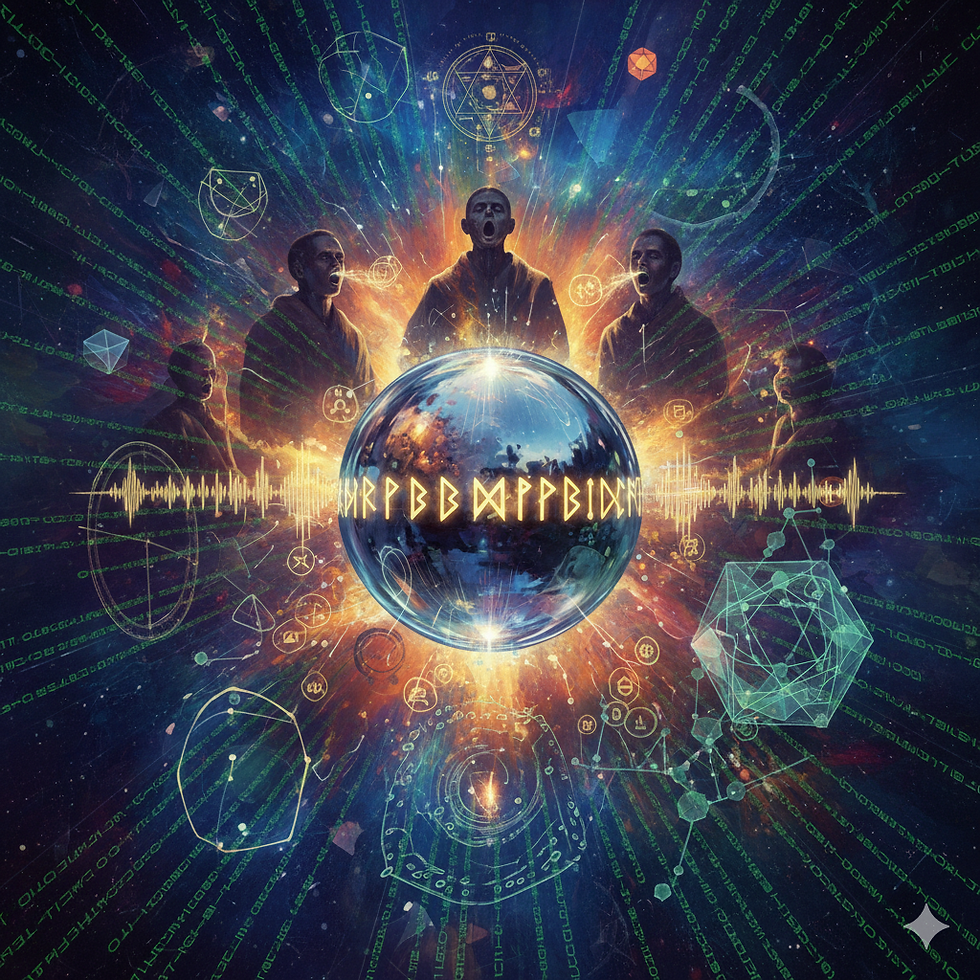
Videos claiming the object “responds” to Sanskrit chants and emits vibrations circulated online; these are compelling to watch but not evidence of a genuine material reaction in the scientific sense — they require controlled tests and measurement equipment to move beyond anecdote. The Times of India
Social posts assert that resin or organic matter inside the sphere has been carbon-dated to ~12,560 years, but I could not find a publicly released, independently verified carbon-dating report in reputable journals or from accredited labs. Extraordinary claims like ancient internal organics need verifiable lab documentation. (At present this appears to be unverified social-media reporting.) Facebook+1
AI-based attempts to “translate” the surface symbols into messages about consciousness and environmental stewardship are interesting as cultural artifacts, but AI interpretation is not the same as linguistic or epigraphic proof — specialist linguists and epigraphers would need to examine high-resolution images and contextual analysis. New York Post

Has it been debunked?
There is no publicly released, independently replicated laboratory report proving extraterrestrial manufacture or exotic physics.
There is also no definitive public proof that the object is a modern art piece, hoax, or conventional debris — though that remains a plausible explanation and skeptical analyses point toward terrestrial possibilities. Metabunk+1
In short: the Buga Sphere is unexplained in public reporting but not confirmed as alien or anomalous by the standards that would satisfy the wider scientific community.

What would settle this (and what to watch for)
If you want to follow this responsibly, look for:
Independent lab analyses published or released by accredited institutions (elemental analysis such as XRF, ICP-MS; metallography; isotopic ratios; CT/CAT scans with raw data).
Chain-of-custody documentation proving the specimen tested is the same item recovered in Buga.

Peer review or at least replication — other labs should be able to reproduce key findings.
High-resolution imagery of the inscriptions and expert epigraphic/linguistic assessment.
Clear authoritative statements from recognized scientific bodies or university labs that performed the tests. People.com+1

Bottom line
The Buga Sphere is a modern example of how a striking object + dramatic video = immediate global speculation. Right now the story sits in this middle zone: interesting and worthy of proper scientific testing, but not proven to be extraterrestrial or anomalous in any extraordinary sense. Skepticism and curiosity both apply — demand transparent, repeatable analyses before accepting extraordinary claims.
Until independent labs publish clear data or the object is demonstrated to defy known physical explanations, the responsible stance is cautious uncertainty, not certainty in either direction. People.com+1
Timeline — verified public events & lab-style releases (through Oct 19, 2025)
The Buga Timeline

March 2, 2025 — Discovery reported in Buga, Valle del Cauca, Colombia
Local videos and eyewitness reports of a round metallic object flying/landing in Buga first circulated; physical specimens were shown to journalists and online. (origins reported in multiple outlets and social posts). Medium+1

May 2025 — X-ray / CT-style imaging publicly shown (informal videos)
Shortly after recovery, people claiming to have X-ray and CT images of the sphere posted scans and videos (some on social platforms and Facebook posts showing CT/X-ray footage). These were preliminary, informal images shown in non-academic settings; no raw DICOM data or full lab reports have been published with chain-of-custody documentation. Facebook+1

May–June 2025 — Early media coverage quoting researchers and radiologist commentary
Tabloid and local outlets ran interviews with people who examined the object (radiologist-like commentators described dense internal layers, several concentric shells, and small internal spheres). These sources conveyed initial impressions but did not provide full lab certificates or peer-reviewed analyses. (Example coverage summarized in press pieces). New York Post+1

Summer–Fall 2025 — Multiple groups and individuals publish analyses, preprints, and commentary (non-peer-reviewed)
A number of independent researchers and online authors posted technical-sounding documents (SSRN/OSF/Medium/Blogs) offering models, CT interpretations, and hypotheses about the sphere’s structure and possible physics. These are useful for discussion but are not the same as independent, accredited-lab analytical reports. SSRN+1

Sep–Oct 2025 — Radiocarbon / “12,560 years” claims appear (social posts, blogs, private-lab pages)
Several social-media posts and a few non-mainstream websites began circulating a radiocarbon age of ~12,560 years for a resin/organic sample said to be extracted from the sphere (posts reference labs or lab-sounding names).

However: no accredited, peer-reviewed radiocarbon lab report with sample codes, lab certificate, methodology, calibration curve, or chain-of-custody has been publicly produced by recognized isotope facilities (e.g., known university radiocarbon centers) in a way that can be independently verified. Sources reporting the 12,560-year number include lab-style pages and social posts. Treat these as claimed results pending independent verification. https://blackwell-lab.com/+2Metabunk+2

Status as of Oct 19, 2025 — Unresolved; no publicly verifiable, peer-reviewed lab release
There are many lab-style claims and preliminary scans, but no universally accepted, independently verifiable lab report (i.e., accredited lab certificate, raw scan archives, isotopic tables, peer-reviewed paper) has been released publicly that settles the object’s origin.
Skeptic communities and technical forums are actively discussing and critiquing the available scans and claimed dates; they highlight methodological concerns (contamination, chain-of-custody issues, ambiguous imaging interpretations). Metabunk+1

Credibility notes on commonly cited items
CT / X-ray videos posted on social media — helpful but low credibility unless raw DICOM files + operator details and instrument calibration are provided. (Source: social posts / Facebook videos). Facebook
Radiocarbon claim (12,560 years) — large, eye-catching claim circulating on multiple websites and social posts. Credibility depends entirely on which lab performed the dating, sample pretreatment, whether the sample was in situ, and whether a lab certificate with sample ID and calibration details is published. At present the publicly visible evidence is incomplete / unverified. https://blackwell-lab.com/+1
Independent analyses on SSRN/OSF/Medium — useful for hypotheses and engineering-style readings, but these are preprints/blog analyses, not independent laboratory confirmations. SSRN+1

How to tell a verifiable lab release from noise (quick checklist)
When a new “lab release” appears, check for all of the following before treating it as authoritative:
Accredited lab ID & certificate — lab name, official sample ID number, method used (e.g., AMS radiocarbon on fraction X), and lab signature.
Chain-of-custody documentation — who handled the specimen, timestamps, and sample provenance proving the sample originated in the recovered object.
Raw data or full report — DICOM files for CT/X-ray, raw spectra for ICP-MS/XRF, lab calibration curves, isotopic ratios, and methodology.
Independent replication — the same sample or an independent subsample analyzed by a second accredited lab with consistent results.
Publication or review — either a peer-reviewed paper, or a report from a recognized research institution/university lab with transparent methods.If a post fails the checklist — treat it as unverified until more data are produced.

Sources and further reading
People — “Scientists studying a mysterious metal sphere…” (May 2025). People.com
The Jerusalem Post — coverage and scientist quotes (May–June 2025). The Jerusalem Post
India Today — summary of reported scans and structure (May 25, 2025). India Today
Metabunk — community technical discussion and skeptical analysis of videos and claims. Metabunk
Times of India — notes on viral chant videos and public reaction. The Times of India


Comments